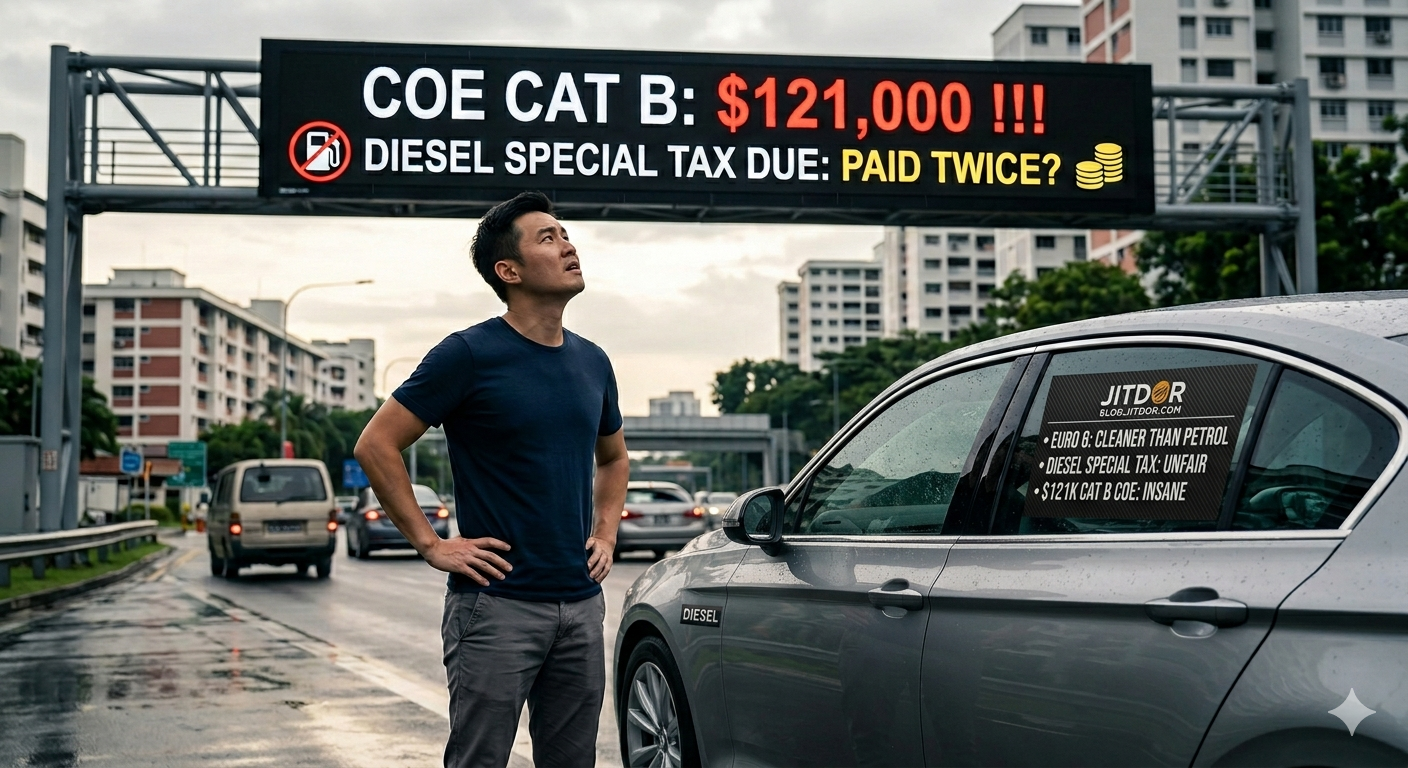
I’ve reached my limit with the automotive landscape in Singapore. If you follow this blog, you know I appreciate engineering—whether it’s a cinema camera or a well-tuned engine. But right now, the logic behind our vehicle taxation feels less like “policy” and more like a targeted shakedown.
The “Special Tax” Ghost
Let’s talk about the Diesel Special Tax. For those who don’t drive diesel, here’s the history lesson: This tax was originally implemented to “compensate” for the fact that diesel wasn’t taxed at the pump. It was a lump-sum way for the government to get their cut since diesel was traditionally seen as a “commercial” fuel.
Then, years ago, they introduced a Diesel Duty at the pump (currently around $0.20 per litre). Logic would dictate that once you start taxing the fuel at the source, the “Special Tax” (the one meant to replace the fuel tax) should vanish.
Spoiler alert: It didn’t. So now, diesel car owners are effectively double-taxed. We pay at the pump like everyone else, and then we get hit with a “Special Tax” invoice every six months just for the privilege of owning a high-torque, efficient engine.
The Great Price Flip: Diesel is the New “Premium”
If double taxation wasn’t enough, look at the boards at any Shell or Caltex today. Diesel is currently retailing at approximately $4.68 per litre. That is significantly more expensive than even 98-octane premium petrol.
The old justification for the Special Tax was: “Diesel is cheaper, so you pay more in road tax to balance it out.” That argument is now dead. I am paying more at the pump, paying the fuel duty, AND paying the Special Tax. It’s a triple penalty that defies economic logic.
Cleaner Than Your Petrol Car?
The biggest irony? My car is Euro 6 compliant.
In any rational world, Euro 6 diesel engines are engineering marvels. Thanks to AdBlue (Selective Catalytic Reduction) and Particulate Filters, these engines often produce lower CO2 emissions and comparable NOx levels to their petrol counterparts. Yet, the tax structure treats us like we’re driving 1980s smoke-belchers. We’re being penalized for choosing a more efficient, high-tech powertrain that actually aligns with “green” goals.
The $121,000 Elephant in the Room
And then we have the latest COE results. $121,000 for Category B. Let that sink in. Before you even buy the four wheels, the seats, or the engine, you are paying over six figures just for a piece of paper that says you can park it in your driveway. We are now at a point where the COE alone costs more than a luxury sedan in almost any other country on Earth.
When you combine a $120k+ COE with a diesel regime that ignores both environmental science and current fuel market realities, the message from the authorities is loud and clear: We don’t care if the math doesn’t add up. Just pay.
It’s getting harder to justify the “passion for driving” when the system is designed to bleed you dry at every turn—from the bidding booth to the petrol station, all the way to the LTA tax portal.
What do you guys think? Is it time to give up on the diesel dream, or is the whole system just fundamentally broken? Let me know in the comments.